In many organisations, leadership is often associated only with executives or senior management. Yet the reality of modern business is that effective organisations depend on leadership at every level. From executives defining long-term strategy to team leaders guiding daily operations, each tier of leadership plays a critical role in shaping performance, culture, and growth.
Businesses that recognise this interconnected structure tend to outperform those that rely on a purely top-down leadership model. According to the Gallup, companies with highly engaged teams can see up to 23% higher profitability and significantly improved productivity, demonstrating the importance of strong leadership across all levels of an organisation.
Understanding how leadership tiers function—and how they support each other—creates a more resilient and adaptive business ecosystem.
Executive Leadership: Setting Vision and Direction
At the highest level of an organisation, executives are responsible for defining the company’s long-term strategy, vision, and external positioning. Their decisions shape investment priorities, partnerships, and market expansion strategies.
Executives must focus on the broader economic environment, emerging industry trends, and long-term sustainability. According to research by the McKinsey & Company, organisations with clear strategic alignment across leadership levels are significantly more likely to outperform competitors in revenue growth and operational efficiency.
Advice for executive leaders:
- Communicate vision consistently and clearly across the organisation.
- Invest in leadership development throughout the company.
- Encourage transparency and accountability in decision-making.
Executives set the direction, but their success depends on how effectively that vision is implemented across the organisation.
Middle Management: Translating Strategy into Action
Middle managers often serve as the bridge between strategy and execution. They translate executive decisions into operational plans and ensure teams understand how their daily work contributes to larger organisational goals.
This leadership tier plays one of the most complex roles in business because it requires balancing upward communication with operational oversight. Middle managers must understand both strategic priorities and frontline realities.
Research from the Harvard Business Review frequently highlights the importance of middle management in organisational performance, particularly in maintaining employee engagement and ensuring operational consistency.
Advice for middle managers:
- Focus on communication between teams and leadership.
- Translate high-level strategy into clear, actionable objectives.
- Identify challenges early and provide practical solutions.
When middle management is strong, businesses experience smoother operations and stronger alignment between strategy and execution.
Frontline Leaders: Driving Daily Performance
Frontline supervisors, team leaders, and department heads are often the closest leaders to employees and customers. Their influence directly shapes workplace culture, productivity, and employee engagement.
According to the Gallup, managers account for up to 70% of the variance in employee engagement, illustrating how critical frontline leadership is to organisational success.
These leaders ensure that processes run efficiently and that teams remain motivated and focused on delivering results.
Advice for frontline leaders:
- Focus on building strong relationships with team members.
- Encourage accountability and collaboration within teams.
- Identify opportunities for operational improvement.
Frontline leaders transform organisational strategy into tangible results every day.
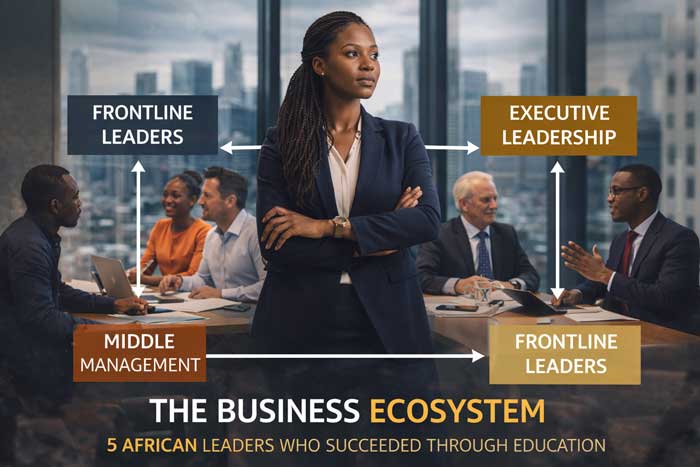
A Symbiotic Leadership Ecosystem
The most successful organisations operate like ecosystems rather than hierarchies. Each leadership tier depends on the others to function effectively.
- Executives provide vision and long-term strategy.
- Middle managers ensure alignment and execution.
- Frontline leaders drive performance and team engagement.
When these roles work together symbiotically, organisations become more agile, innovative, and resilient. Communication flows more effectively, decisions are implemented more efficiently, and employees feel connected to the broader mission of the company.
The Future of Leadership
In today’s rapidly evolving business environment—shaped by technology, global competition, and changing workforce expectations—leadership can no longer exist in isolated tiers. Organisations must build integrated leadership cultures where every level contributes to strategic success.
Businesses that invest in leadership development across all tiers will not only improve internal performance but also create stronger organisations capable of navigating uncertainty and seizing new opportunities.
Ultimately, the strength of a company’s leadership is not measured only by its executives—but by how effectively every level of leadership works together to achieve a shared vision.